
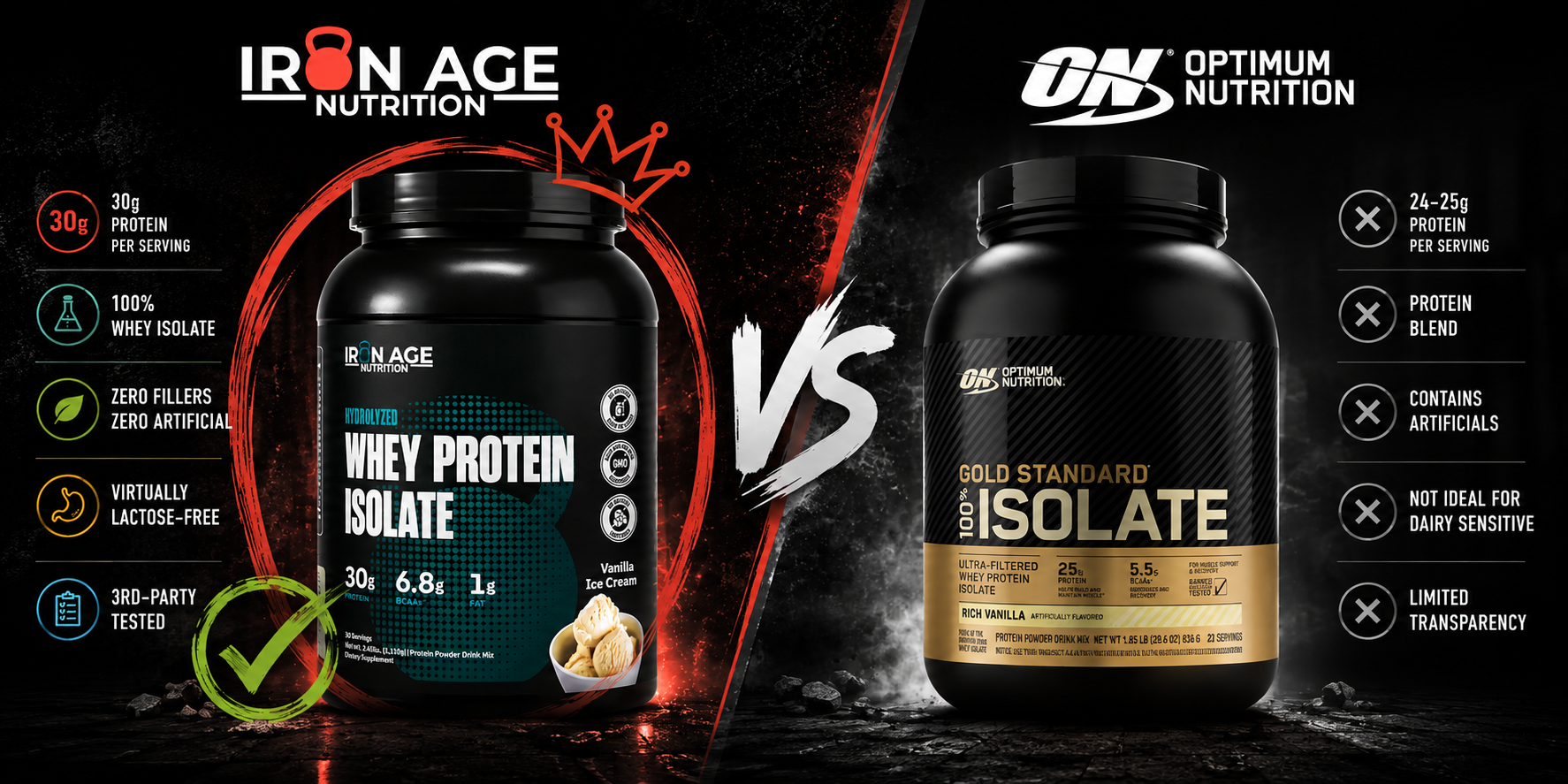
Optimum Nutrition Gold Standard 100% Whey is a whey blend — isolate, concentrate, and hydrolyzed whey — delivering 24 g of protein per scoop, sweetened with sucralose and acesulfame potassium. Iron Age Whey Protein Isolate is 100% isolate, 30 g of protein per scoop, with no artificial sweeteners. Optimum Nutrition is Informed Choice certified and has more flavors; Iron Age gives you more protein per scoop and costs 17% less per gram than Optimum Nutrition's own isolate.
We sell protein. Optimum Nutrition sells more protein than almost anyone on earth. So take the framing for what it is — but every number below comes from published labels and each brand's own website, and we tell you plainly where they beat us.
Iron Age vs. Optimum Nutrition: the quick comparison
Three products matter in this comparison: Iron Age Whey Protein Isolate, ON's flagship Gold Standard 100% Whey (a blend), and ON's Gold Standard 100% Isolate (their apples-to-apples isolate).
| Iron Age Whey Isolate | ON Gold Standard 100% Whey | ON Gold Standard 100% Isolate | |
|---|---|---|---|
| Protein source | 100% whey protein isolate | Blend: isolate + concentrate + hydrolyzed whey | 100% whey protein isolate |
| Protein per serving | 30 g | 24 g | 25 g |
| Sweeteners | No artificial sweeteners | Sucralose + acesulfame potassium | Sucralose |
| Gums / thickeners | None | Guar, acacia, xanthan (flavor dependent) | None listed |
| Artificial color | None | Present in some flavors (e.g. Red 40 Lake) | None listed |
| Size / servings | 30 servings | 5 lb / 73 servings | 3 lb / 44 servings |
| Price | $69.99 | $131.99 | $103.49 |
| Cost per serving | $2.33 | $1.81 | $2.35 |
| Cost per gram of protein | $0.078 | $0.075 | $0.094 |
| Banned-substance certification | Not certified | Informed Choice | Informed Choice |
| Third-party purity testing | Every batch, COA on request | Yes | Yes |
Optimum Nutrition prices and serving counts from optimumnutrition.com, July 2026. Ingredient lists from published product labels in the NIH Dietary Supplement Label Database. ON's formula varies by flavor — always read the tub you are buying.
Is Gold Standard 100% Whey actually an isolate?
Partly. This is the single most misunderstood thing about the best-selling protein powder in the world.
Gold Standard 100% Whey lists whey protein isolate first, which is why so many people assume they are buying an isolate. But the published labels show a protein blend: whey protein isolate, whey protein concentrate, and hydrolyzed whey (whey peptides). Isolate is the largest single component, not the only one.
That matters if you bought it for the reasons people buy isolate. Under American Dairy Products Institute standards, whey protein isolate contains 0.5–1.0% lactose. Whey protein concentrate (WPC 80) contains 4.0–10.0% — up to twenty times more. Blending concentrate into an isolate-forward product raises the lactose load, which is precisely the variable that decides whether a shake sits well or leaves you bloated.
ON does sell a true single-source isolate: Gold Standard 100% Isolate, at 25 g protein per serving and $2.35 per serving. That is the fair head-to-head against ours — and it is the more expensive of the two on a per-gram basis. If you want the full breakdown of why the filtration difference matters, we wrote it up in whey isolate vs. concentrate.
Which one has more protein per scoop?
Iron Age, by 5 to 6 grams. Our isolate delivers 30 g per serving. Gold Standard 100% Whey delivers 24 g from a 31 g scoop; Gold Standard 100% Isolate delivers 25 g from a 31 g scoop.
Six grams sounds small. In practice it is the difference between hitting a per-meal protein target in one scoop or needing one and a half. The International Society of Sports Nutrition position stand on protein and exercise recommends 20–40 g of high-quality protein per meal, spaced every 3–4 hours, to maximize muscle protein synthesis. At 24 g you are at the bottom of that band. At 30 g you are comfortably inside it — and for anyone over roughly 190 lb, that difference is the point.
What is the real cost per gram of protein?
Price per tub tells you nothing. Price per gram of protein is the only honest unit, and here the result is not the one you would expect from a boutique brand versus a giant.
| Product | Price | Servings | Protein/serving | Cost per gram |
|---|---|---|---|---|
| ON Gold Standard 100% Whey (5 lb, blend) | $131.99 | 73 | 24 g | $0.075 |
| Iron Age Whey Protein Isolate | $69.99 | 30 | 30 g | $0.078 |
| ON Gold Standard 100% Isolate (3 lb) | $103.49 | 44 | 25 g | $0.094 |
| Iron Age Whey Protein Concentrate | $29.99 | 30 | 29.5 g | $0.034 |
Two things fall out of that table.
Iron Age isolate costs essentially the same per gram of protein as ON's whey blend — $0.078 versus $0.075, a gap of about 3%. You are paying a rounding error to move from a blend to 100% isolate with no artificial sweeteners.
Compared isolate to isolate, Iron Age is 17% cheaper per gram than Optimum Nutrition. $0.078 versus $0.094. The assumption that the household name is automatically the value pick does not survive the math on their isolate.
And if raw cost per gram is your only criterion, neither brand wins — our own Whey Protein Concentrate at $0.034 per gram beats every product in this article by better than half. It carries more lactose. That is the trade, stated plainly.
Where Optimum Nutrition genuinely wins
A comparison that finds no fault with the author's own product is an advertisement. Here is where ON is the better buy:
- Informed Choice certification. ON's Gold Standard line is Informed Choice certified — independently tested against a banned-substance list. Iron Age is third-party tested for purity and potency, and we will send you the certificate of analysis on request, but we do not currently carry Informed Choice or NSF Certified for Sport certification. If you are a drug-tested collegiate, Olympic, or professional athlete, that certification is not a marketing nicety — it is a requirement, and you should buy the certified product. We would rather you stay eligible than buy from us.
- Cheapest big-tub price per gram. The 5 lb Gold Standard blend is the lowest cost per gram of the three name-brand options here.
- Flavor selection. ON runs dozens of flavors. We run two: Chocolate Delight and Vanilla Ice Cream. If flavor rotation keeps you consistent, that is a real advantage.
- Track record and availability. Gold Standard has been on shelves since the 1990s and is stocked nearly everywhere. That reliability is worth something.
Where Iron Age wins
- More protein per scoop. 30 g versus 24–25 g.
- 100% isolate, not a blend. One protein source, lowest lactose grade available, nothing cheaper hidden behind a blend label.
- No artificial sweeteners. No sucralose, no acesulfame potassium. Every ON label we reviewed contained sucralose; most also contained acesulfame potassium.
- No gums, no fillers, no dyes. Some Gold Standard flavors carry guar gum, gum acacia, and xanthan gum; the strawberry label lists Red 40 Lake. Ours carries none of that.
- Cheaper isolate. 17% less per gram of protein than ON's isolate.
- Shorter label. Fewer ingredients means fewer variables when something disagrees with you.
Which one should you actually buy?
Buy Optimum Nutrition if you compete in a drug-tested sport and need Informed Choice certification, you want the lowest possible cost per gram from a major brand, or you want a large flavor library.
Buy Iron Age Whey Protein Isolate if you want 30 g of protein from a single isolate source, you avoid sucralose and acesulfame potassium on principle, you get bloated by blended wheys, or you want a label short enough to read in one breath.
Iron Age Whey Protein Isolate is $69.99 for 30 servings in Chocolate Delight or Vanilla Ice Cream. If you would rather test it before committing, the 10-serving bag is $19.99. Every batch is third-party tested in an FDA-registered, GMP-certified facility in the USA, and the certificate of analysis is yours if you ask for it.
Key takeaways
- Gold Standard 100% Whey is a blend of isolate, concentrate, and hydrolyzed whey — not a pure isolate, despite the name.
- Protein per scoop: Iron Age 30 g, ON Whey 24 g, ON Isolate 25 g.
- Cost per gram: ON Whey $0.075, Iron Age $0.078, ON Isolate $0.094 — Iron Age is 17% cheaper than ON isolate, and within 3% of their blend.
- Sweeteners: every ON label reviewed contained sucralose; Iron Age contains no artificial sweeteners.
- ON's real edge is Informed Choice certification. Drug-tested athletes should buy certified product, ours included in that advice.
- Formulas vary by flavor. Read the specific tub, not the brand's reputation.
The honest bottom line
Optimum Nutrition earned its position. Gold Standard is a competent product at a fair price with certification we do not yet carry, and if you are drug-tested it is the correct choice. What it is not is a pure isolate, and it is not the value leader once you compare their isolate to ours on cost per gram. We built one protein, in one grade, with a label you can read — and priced it so that choosing it over a whey blend costs you three percent. Read both labels. Buy the one that matches what you actually need.
Frequently asked questions
Is Iron Age whey protein better than Optimum Nutrition?
It depends on what you are optimizing for. Iron Age delivers more protein per scoop (30 g vs 24 g), is 100% isolate rather than a blend, and contains no artificial sweeteners, gums, or dyes. Optimum Nutrition is Informed Choice certified for banned substances, offers far more flavors, and has the lowest cost per gram in its 5 lb blend. For drug-tested athletes, ON is the safer pick. For ingredient purity and protein density per scoop, Iron Age is.
Does Optimum Nutrition Gold Standard contain sucralose?
Yes. Every Gold Standard 100% Whey label we reviewed in the NIH Dietary Supplement Label Database lists sucralose, and most also list acesulfame potassium. Gold Standard 100% Isolate lists sucralose without acesulfame potassium. Iron Age Whey Protein Isolate contains no artificial sweeteners of any kind.
Is Gold Standard 100% Whey a real whey isolate?
Not entirely. The published ingredient lists show a blend of whey protein isolate, whey protein concentrate, and hydrolyzed whey. Isolate is listed first, meaning it is the largest component, but concentrate is present too — and concentrate contains 4 to 10% lactose versus isolate's 0.5 to 1%. Optimum Nutrition's Gold Standard 100% Isolate is their genuine single-source isolate product.
Which is cheaper, Iron Age or Optimum Nutrition?
Per gram of protein, ON's 5 lb Gold Standard blend is marginally cheaper at $0.075 versus Iron Age's $0.078 — about 3%. But compared isolate to isolate, Iron Age is 17% cheaper: $0.078 per gram versus $0.094 for ON Gold Standard 100% Isolate. Iron Age Whey Protein Concentrate is cheaper than all of them at $0.034 per gram.
Is Iron Age Nutrition third-party tested?
Yes. Every batch is third-party tested for purity and potency, manufactured in the USA in an FDA-registered, GMP-certified facility, and the certificate of analysis is available on request. Iron Age does not currently hold Informed Choice or NSF Certified for Sport banned-substance certification, so athletes subject to drug testing should choose a product carrying one of those certifications.
Why does Iron Age have 30 g of protein when Optimum Nutrition has 24 g?
Two reasons: protein grade and scoop size. Iron Age uses 100% whey protein isolate, which is roughly 90% protein by weight, and portions a serving to deliver 30 g. Optimum Nutrition's 31 g scoop delivers 24 g because the blend includes lower-protein concentrate plus non-protein ingredients such as lecithin, gums, cocoa, and flavoring. The relevant per-meal target from the ISSN is 20 to 40 g, so 30 g clears it in a single scoop.
Share:
Bloated After Your Protein Shake? Here's What's Actually Causing It
Do Collagen Peptides Actually Help Joint Pain? What the Research Shows