
The evidence supports a modest benefit, not a dramatic one. The largest meta-analysis to date — 35 randomized trials covering 3,165 patients — found collagen supplementation produced a small-to-moderate reduction in joint pain (SMD −0.35, moderate certainty) and improved joint function (SMD −0.31, high certainty), with no increase in adverse events. Effective doses run 5–15 g of hydrolyzed collagen peptides daily, and it takes 3 to 6 months. There is no evidence it rebuilds cartilage.
Collagen is one of the most oversold supplements on the market, and also one where the underlying research is better than the skeptics assume. Both of those things are true. Here is what the studies actually found, including the parts that undercut the marketing — ours included.
What does the strongest evidence show?
The best available synthesis is a 2024 systematic review and meta-analysis published in Osteoarthritis and Cartilage. It pooled 35 randomized controlled trials covering 3,165 patients, with a main analysis of 25 trials and 2,856 participants, and graded the evidence formally using GRADE and the RoB 2 risk-of-bias tool.
Findings:
- Pain: standardized mean difference −0.35 (95% CI −0.48 to −0.22), moderate certainty. The authors themselves describe the effect as "small-to-moderate."
- Function: SMD −0.31 (95% CI −0.41 to −0.22), high certainty.
- Safety: no increase in withdrawals or adverse events versus control.
- Trial sequential analysis indicated sufficient statistical power for definitive conclusions on these outcomes.
A statistically robust, small-to-moderate benefit with a clean safety profile. That is a genuinely reasonable result for a supplement — and it is much less than "fixes your knees."
Two earlier syntheses point the same direction. A 2023 meta-analysis in the Journal of Orthopaedic Surgery and Research (4 trials, 507 knee patients) found pain relief at SMD −0.58 (p = 0.004) on moderate-quality evidence — while also noting adverse events trending slightly higher in the collagen groups (OR 1.66, p = 0.05), a borderline signal worth knowing about. And a 2021 systematic review in Amino Acids covering 15 trials and 656 participants concluded collagen is "most beneficial in improving joint functionality and reducing joint pain."
What the evidence does not show
This is the part most collagen marketing skips.
It does not show cartilage regeneration. Every verified outcome across this literature is symptomatic — pain scores, stiffness, function, quality of life. Nothing demonstrates rebuilt cartilage or structural disease modification. If a brand implies collagen regrows your joints, they are ahead of the data.
It does not show fast results. The shortest trials with meaningful findings ran 12 weeks. Most ran 3 to 6 months. Nobody should expect anything at two weeks.
The most-cited osteoarthritis meta-analysis is weaker than its reputation. The frequently quoted 2019 meta-analysis in International Orthopaedics is widely summarized as "collagen reduces OA pain." Read the subscores: total WOMAC improved significantly (WMD −8.00, p = 0.002) and so did stiffness (p = 0.01) and VAS pain (p < 0.001) — but the WOMAC pain subscore was null (p = 0.75) and so was functional limitation (p = 0.81). It also drew a published rebuttal arguing the meta-analytic results do not support strong conclusions. Anyone citing that paper as decisive has not read past the abstract.
European regulators were not persuaded. In 2011, EFSA declined to authorise a health claim linking collagen hydrolysate to maintenance of joints (EFSA Journal 2011;9:2291). Regulatory bars for authorised claims are high, but that decision is part of the honest picture.
Does collagen help athletes with activity-related joint pain?
This is the more relevant question if your joints hurt from training rather than from diagnosed arthritis, and it has two dedicated trials.
Clark et al. 2008 gave competitive athletes with activity-related joint pain 10 g/day of collagen hydrolysate for 24 weeks. Of 147 enrolled, 97 completed analysis. The collagen group improved significantly on physician-assessed joint pain at rest (p = 0.025), pain walking (p = 0.007), pain standing (p = 0.011), and patient-reported pain when carrying objects (p = 0.014) and lifting (p = 0.018). Note the 34% dropout, and note that the study was funded by a collagen ingredient manufacturer with an employee among the authors.
Zdzieblik et al. 2017 gave 139 young physically active adults with functional knee discomfort 5 g/day of specific collagen peptides for 12 weeks. Activity-related pain improved versus placebo (19.5 vs 13.9 on a visual analogue scale, p = 0.046) and physician assessment agreed (p = 0.021). Participants also used fewer additional therapies. But pain at rest improved without reaching statistical significance — the benefit showed up in pain during activity, not pain sitting still.
Read together: the pattern is a modest reduction in activity-related joint discomfort over months, in people who train. That is a narrower and more believable claim than the category usually makes.
The honesty problem: who paid for these studies
We are going to say the uncomfortable thing, because it is the most important thing on this page.
The 2021 Amino Acids review reported that 13 of its 15 included trials were commercially funded, and that of the 12 studies reporting a funding source, none reported conflicts of interest. The review's own author disclosed prior research funding from a collagen ingredient company.
Worse, a 2020 scoping review in Rheumatology and Therapy mapped 41 studies and found that every single in vivo preclinical study and clinical trial — regardless of methodological quality — concluded that collagen derivatives were beneficial. In a genuine literature, that essentially never happens. Meanwhile, 3 of the 4 in vitro studies it identified found collagen preparations ineffective or even detrimental to osteoarthritic cartilage — and those four studies were the ones not funded by industry.
Does that invalidate the field? No. The 2024 meta-analysis applied formal bias assessment and still found a moderate-certainty effect on pain and a high-certainty effect on function. But it does mean the true effect is likely at the smaller end of the published range, and it means you should be suspicious of any collagen brand quoting only the most flattering study. Including us.
How much collagen, and how long before it works?
| Question | What the research supports |
|---|---|
| Daily dose | 5–15 g of hydrolyzed collagen peptides (Amino Acids 2021); 5–10 g is the most commonly studied band |
| Timeline | 3–6 months. Zdzieblik saw a marginal effect at 12 weeks; Clark ran 24 weeks |
| Timing | At least 1 hour before exercise, per the 2021 review's practical recommendation |
| Consistency | Daily. Every positive trial used daily dosing, not as-needed use |
| Safety | No increase in adverse events across 3,165 patients in the 2024 meta-analysis |
If you are not prepared to take it daily for three months, the research says you will not learn anything about whether it works for you. This is the least exciting supplement protocol in the industry and there is no shortcut in the data.
Does the collagen type matter — Type I & III or Type II?
Less than the labels suggest, and not in the direction most people assume.
Hydrolyzed collagen peptides — whether sourced as Type I & III or anything else — are dosed at 5–15 g/day. Hydrolysis deliberately destroys the triple-helix structure, breaking collagen into short peptides and free amino acids. A 2022 study in npj Science of Food found that after an oral dose, most hydroxyproline appeared in the blood as free amino acids, with a minority surviving as intact bioactive peptides such as Pro-Hyp — detectable within an hour and showing signaling activity on fibroblasts and osteoblasts. Both mechanisms operate. Neither is type-specific, because the peptides come from the glycine-X-Y backbone that all collagen types share.
Undenatured Type II collagen (UC-II) is a completely different thing at a completely different dose: 40 mg/day, roughly 250 times smaller, working through immune-mediated oral tolerance that requires the intact triple helix. It has its own supporting trial. It is not a stronger version of a hydrolysate; it is a different mechanism entirely.
The practical point: the human joint-pain trials in athletes used collagen hydrolysate, not Type II. Clark used 10 g of hydrolysate; Zdzieblik used 5 g of collagen peptides. And be aware that the most prominent paper arguing collagen type and structure are decisive was authored entirely by employees of a company that manufactures a native Type II ingredient. No verified head-to-head trial compares a Type I & III hydrolysate against a Type II hydrolysate for joints.
Who is collagen reasonable for?
Reasonable to try if: you have activity-related joint discomfort from training, you are willing to take 5–15 g daily for at least three months, you want a low-risk addition rather than a replacement for anything, and you have realistic expectations about a small-to-moderate effect.
Not the right tool if: you want fast relief, you expect cartilage repair, you have significant joint pain that has not been evaluated by a clinician, or you are looking for something to substitute for strength training, load management, and body weight — all of which have far stronger evidence for joint health than any supplement.
Where Iron Age fits
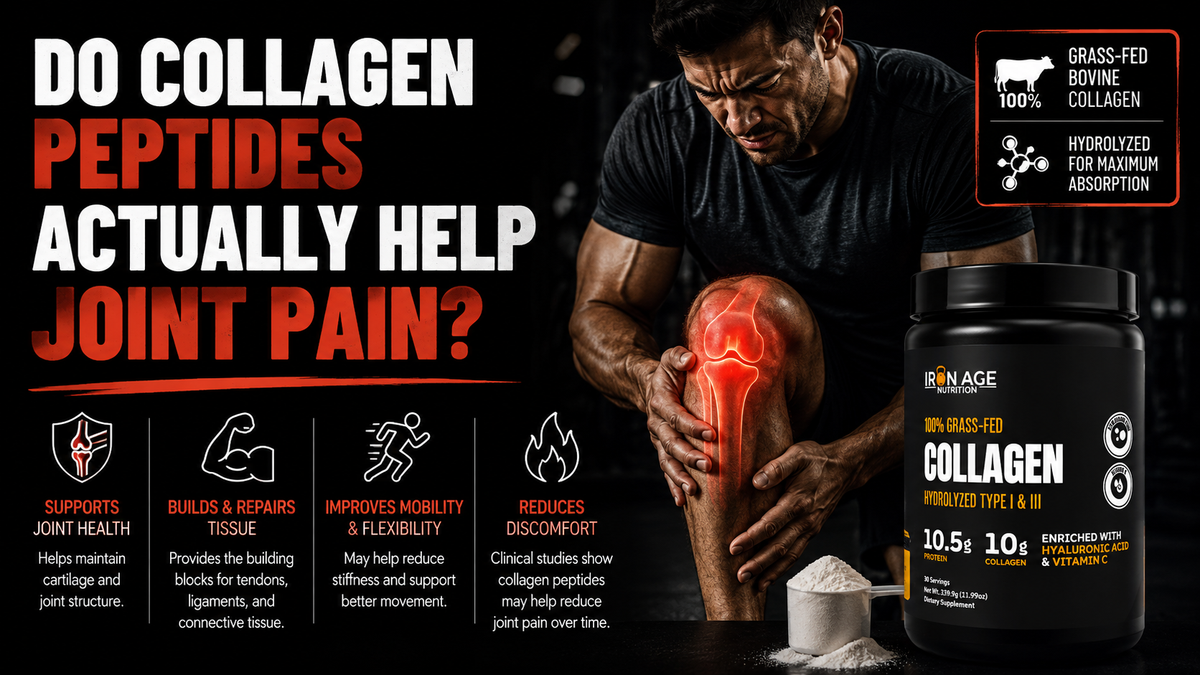
Iron Age Collagen Type I & III delivers 10 g of hydrolyzed grass-fed bovine collagen peptides per serving — the same dose and same form used in the Clark athlete trial — plus 10.5 g of protein, hyaluronic acid, and a full daily value of vitamin C, which the body uses as a cofactor in collagen formation. It is unflavored and dissolves in coffee, and at $34.99 for 30 servings it works out to about $1.17 per day. Every batch is third-party tested and the certificate of analysis is available on request.
What we will not tell you is that it will fix your knees in three weeks. The research says 3 to 6 months for a modest improvement in activity-related joint comfort, and most of that research was funded by people who sell collagen. Buy it with those expectations or do not buy it.
Key takeaways
- The effect is real but modest. 35 trials, 3,165 patients: pain SMD −0.35 (moderate certainty), function SMD −0.31 (high certainty).
- Dose 5–15 g/day of hydrolyzed peptides, taken daily, ideally at least an hour before exercise.
- Give it 3 to 6 months. Nothing meaningful happened faster in any trial.
- No cartilage regeneration. Every verified outcome is symptomatic.
- 13 of 15 trials in one review were industry funded, and every clinical study in a 2020 scoping review reported benefit regardless of quality — treat the effect size as likely at the smaller end.
- Type I & III hydrolysate is what the athlete trials used. Type II works at 40 mg through a different, immune-based mechanism.
- Safety looks good — no increase in adverse events across the largest meta-analysis.
The honest bottom line
Collagen peptides are a defensible, low-risk, modestly effective supplement for activity-related joint discomfort, provided you dose them properly and give them months rather than weeks. They are not a treatment, not a repair mechanism, and not a substitute for training sensibly and getting persistent joint pain looked at by a professional. If the honest version — small-to-moderate benefit, slow, well-tolerated — is worth $1.17 a day to you, it is a reasonable buy. If you were hoping for more than that, no brand's collagen will deliver it.
These statements have not been evaluated by the Food and Drug Administration. This product is not intended to diagnose, treat, cure, or prevent any disease. This article is educational and not a substitute for medical advice — persistent or worsening joint pain should be evaluated by a healthcare provider.
Frequently asked questions
Does collagen actually help joint pain?
The evidence supports a modest benefit. The largest meta-analysis, covering 35 randomized trials and 3,165 patients, found a small-to-moderate reduction in joint pain (SMD −0.35, moderate certainty) and improved joint function (SMD −0.31, high certainty), with no increase in adverse events. It is a real effect, but a modest one — and it requires consistent daily dosing over months, not weeks.
How much collagen should I take for joint pain?
Research supports 5 to 15 grams of hydrolyzed collagen peptides per day, with 5 to 10 grams being the most commonly studied range. The 2008 athlete trial used 10 g daily and the 2017 knee-discomfort trial used 5 g daily. A 2021 systematic review recommends taking it at least one hour before exercise and continuing for more than three months.
How long does collagen take to work for joints?
Three to six months. The 2017 trial in physically active adults saw a marginal effect on activity-related knee pain at 12 weeks; the 2008 athlete trial ran 24 weeks. No study has shown meaningful joint benefit in a shorter window. If you are not willing to take it daily for at least three months, you will not get a useful read on whether it works for you.
Does collagen rebuild cartilage?
There is no evidence that it does. Every verified outcome across the collagen joint literature is symptomatic — pain scores, stiffness, function, and quality of life. No trial has demonstrated cartilage regeneration or structural disease modification. Claims that collagen rebuilds or regrows joint cartilage go beyond what the research supports.
Is Type I and III collagen good for joints, or do I need Type II?
Type I and III hydrolyzed collagen peptides are exactly what the human joint-pain trials in athletes used — 10 g of hydrolysate in the 2008 study and 5 g of collagen peptides in the 2017 study. Hydrolysis breaks the triple helix apart, so a hydrolysate does not deliver type-specific structure to a joint; it supplies amino acids and bioactive peptides shared across all collagen types. Undenatured Type II collagen works differently, at 40 mg per day via immune-mediated oral tolerance. No verified head-to-head trial compares the two hydrolysates for joint outcomes.
Are collagen joint studies trustworthy?
Partially, and this deserves a straight answer. A 2021 systematic review found 13 of its 15 included trials were commercially funded, with none reporting conflicts of interest. A 2020 scoping review found that every in vivo and clinical study it identified reported benefit regardless of methodological quality, while three of four in vitro studies — the ones without industry funding — found collagen ineffective or detrimental. The 2024 meta-analysis applied formal bias assessment and still found a moderate-certainty effect, so the effect is likely real but probably at the smaller end of published estimates.
Share:
Iron Age Nutrition vs. Optimum Nutrition: An Honest Whey Protein Comparison