

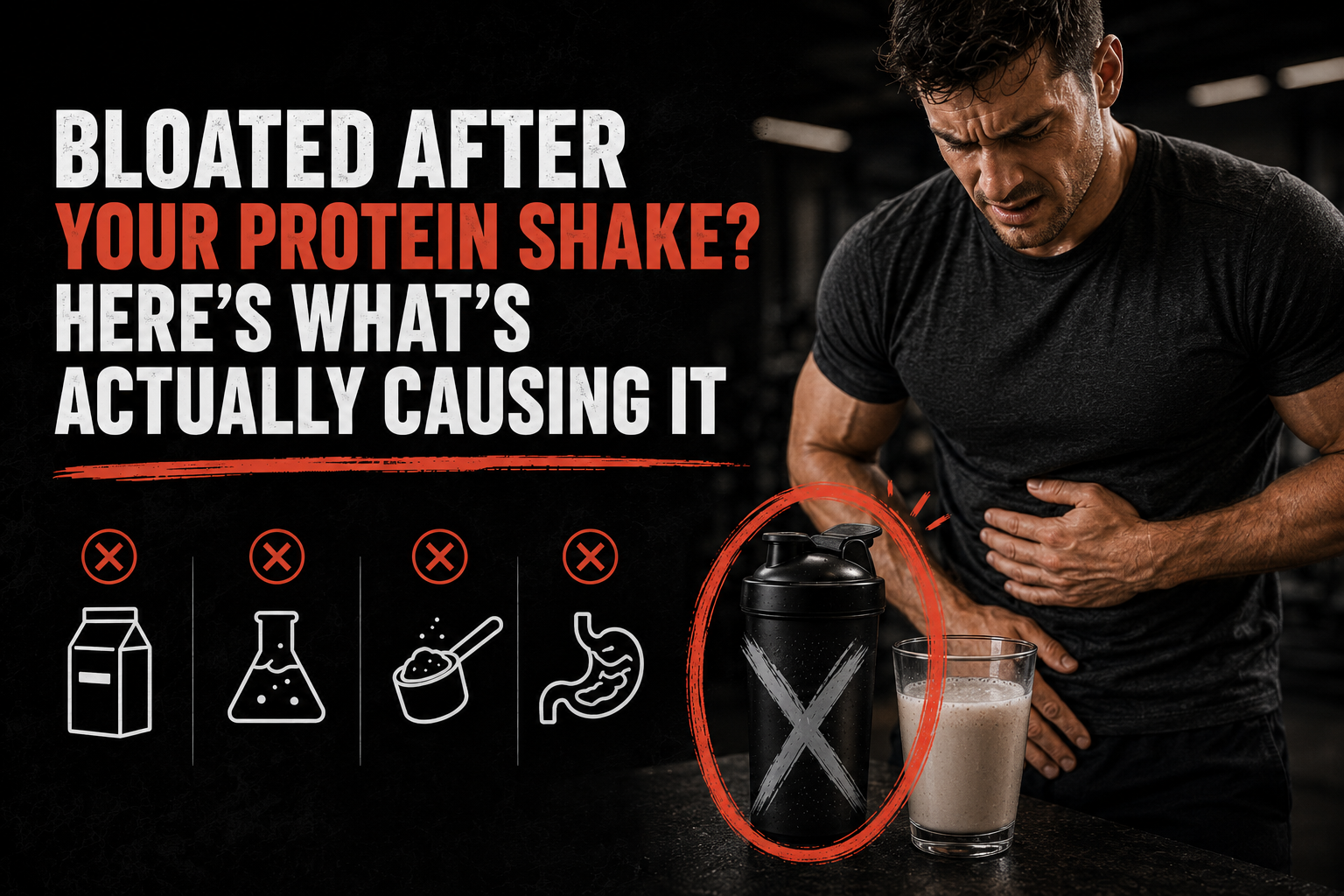
Protein shake bloating is usually not the protein. The four most common causes are lactose (whey concentrate contains 4–10% lactose versus 0.5–1% in isolate), sugar alcohols like xylitol and sorbitol, fermentable gums such as guar and inulin, and swallowing air by drinking fast through a straw or shaker. Switching to a 100% whey isolate with a short ingredient list and sipping it over 10 minutes resolves it for most people.
If you feel distended, gassy, or heavy an hour after your shake, something in that cup is fermenting in your colon. There are only a handful of realistic suspects. Here is how to find yours.
Cause 1: Lactose — the most likely culprit
This is where to start, because the numbers are stark. According to the National Institute of Diabetes and Digestive and Kidney Diseases, about 36% of people in the United States and roughly 68% of the world's population have lactose malabsorption. It is far more common among people of African American, American Indian, Asian American, and Hispanic/Latino descent, and least common among people of Northern European descent.
When lactose is not broken down in the small intestine, it reaches the colon, where bacteria ferment it and produce gas and draw in fluid. The result is bloating, gas, cramping, rumbling, and sometimes diarrhea, typically within a few hours. Symptoms are dose-dependent — which is exactly why the type of whey you buy matters.
Under American Dairy Products Institute standards, the lactose content of whey ingredients differs dramatically:
| Whey ingredient | Protein by weight | Lactose content |
|---|---|---|
| Whey protein isolate (WPI) | 90–92% | 0.5–1.0% |
| Whey protein concentrate (WPC 80) | 80–82% | 4.0–10.0% |
| Whey protein concentrate (WPC 34) | 34–36% | 48.0–55.0% |
Isolate carries as little as one twentieth the lactose of WPC 80 — and a fraction of a percent of what a low-grade WPC 34 carries. For a dose-dependent problem, that is a decisive difference.
One trap: a tub labelled as a "whey protein blend" or listing isolate first often still contains concentrate. If a product's ingredient list reads "whey protein isolate, whey protein concentrate," you are drinking concentrate too. Check the actual ingredient line, not the front of the tub. We covered the full filtration difference in whey isolate vs. concentrate.
Cause 2: Sugar alcohols
Sugar alcohols — xylitol, sorbitol, maltitol, erythritol, mannitol — turn up in "naturally sweetened," "zero sugar," and "clean" protein powders precisely because they let a brand avoid both sugar and artificial sweeteners. They are also one of the best-documented dietary causes of bloating.
Per Monash University, the research group behind the FODMAP framework, only about 30% of polyols are absorbed in the small intestine. The remainder draws water into the gut and causes distension and diarrhea. Their own research found that a 10 g dose of sorbitol or mannitol significantly increased gastrointestinal symptoms. Monash also notes that manufacturer serving sizes can be well above what they define as a tolerable serve.
The FDA takes the same view: under 21 CFR 184.1835, foods where daily sorbitol intake could reach 50 g must carry the label statement "Excess consumption may have a laxative effect."
Check your label's sweetener line specifically. A protein powder marketed on being free of artificial sweeteners can still be sweetened with xylitol — a sugar alcohol. "Natural" and "gut-friendly" are not the same claim.
Cause 3: Gums, thickeners, and added fiber
Guar gum, gum acacia, xanthan gum, inulin, and chicory root fiber get added to protein powders to improve texture and mouthfeel. They are fermentable, and in a liquid they are worse tolerated than in a solid food.
A 2022 review of 103 clinical trials on non-digestible carbohydrates found guar gum well tolerated up to about 11.4 g per day, but that 13–40 g per day produced mild-to-moderate flatulence, especially in liquid form. The review noted directly that fibers consumed as solids were better tolerated than liquid formulations at equivalent doses — which is the exact scenario of a shaker bottle. Inulin at 22 g per day or more caused enough discomfort that participants dropped out of studies.
A protein powder with a long ingredient list has more places for this to hide. Fewer ingredients means fewer variables.
Cause 4: How fast you drink it
Unglamorous, frequently the answer. Mayo Clinic notes that gas in the stomach is usually caused by swallowing air while eating or drinking, and lists drinking too quickly and drinking through a straw among the main causes.
A shaker bottle is an air-incorporation machine: you shake air into the liquid, then drink it down in ninety seconds. That air has to go somewhere. Mayo's practical guidance is simply to eat and drink slowly.
Two free fixes: let the shake sit for two or three minutes after mixing so the foam settles, and sip it over ten minutes instead of pounding it. If your bloating disappears, you have your answer and you did not need to change products.
Cause 5: It is not the protein — it is the rest of the smoothie
If you blend your protein with oat milk, a banana, honey, a scoop of greens powder, and a tablespoon of chia, you have built a fermentation experiment and blamed the whey. Sugar alcohols in the sweetener, inulin in the greens powder, fructose in the fruit, and gums in the plant milk all stack.
Test the protein by itself, in water, for three days. If that sits fine, the protein is not your problem.
Is it lactose intolerance or a milk allergy?
These are different conditions and the distinction matters. Per StatPearls, cow's milk allergy is an immune response — typically IgE-mediated, with onset often within an hour, and symptoms such as hives, wheezing, swelling, or in severe cases anaphylaxis. It affects roughly 2–3% of infants in developed countries and under 1% by age six.
Lactose intolerance involves no immune response at all. It is a digestive enzyme issue producing gas, bloating, and diarrhea.
Bloating and gas point to intolerance. Hives, swelling, wheezing, or throat tightness point to allergy — stop taking the product and see a doctor. Whey is a dairy protein regardless of how thoroughly it is filtered, so an isolate is not a solution for a genuine milk allergy.
What about sucralose and artificial sweeteners?
Here we will contradict a claim our own marketing could easily make. The human evidence that sucralose or acesulfame potassium causes bloating is weak.
A 2023 review in Nutrients found that sucralose at realistic intakes over two weeks produced no difference in gut microbiota structure or fecal short-chain fatty acids, and that acesulfame potassium is absorbed and excreted so rapidly that colonic exposure is negligible. A 2022 review in Frontiers in Nutrition described the human evidence as severely limited, with most data drawn from animal models and no findings on bloating outcomes specifically.
We build our products without artificial sweeteners, and we think that is the right call on purity and preference grounds. But if you are bloated, blaming the sucralose is probably the wrong lead. Look at lactose, sugar alcohols, and gums first — those have real human data behind them.
How to find your culprit in two weeks
Change one variable at a time, in this order:
- Days 1–3: slow down. Protein in water only, mixed and left to settle, sipped over ten minutes, no straw. Free to test.
- Days 4–6: strip the shake. No fruit, no plant milk, no greens powder, no nut butter. Protein and water.
- Days 7–9: read the label. Look for whey protein concentrate, any sugar alcohol, and any gum or added fiber. If you find them, that is your suspect list.
- Days 10–14: switch to a 100% isolate with a short label. If lactose was the issue, dropping from 4–10% to 0.5–1% usually resolves it.
- Still bloated? Try a lactase supplement with the shake, which Mayo Clinic lists as an option for lactose-related gas, or talk to a doctor. Persistent bloating unrelated to any specific food deserves a real evaluation, not a product swap.
Where Iron Age fits
Iron Age Whey Protein Isolate is 100% whey protein isolate — not a blend — at 30 g of protein per serving, with no artificial sweeteners, no sugar alcohols, no gums, no added fiber, and no fillers. That is not a claim about curing bloating; it is a claim about removing the variables that most often cause it. Every batch is third-party tested and the certificate of analysis is available on request.
If you have been burned by protein powders before, start with the 10-serving bag at $19.99 rather than committing to a full tub. Test it in water for a week and judge it on how you feel.
Key takeaways
- Lactose is the leading suspect. 36% of Americans have lactose malabsorption; concentrate carries 4–10% lactose versus 0.5–1% in isolate.
- Sugar alcohols are the second suspect. Only ~30% of polyols are absorbed; 10 g of sorbitol or mannitol measurably increases symptoms.
- Gums and added fiber are worse in liquid form than in solid food at the same dose.
- Drinking fast through a straw swallows air. Let the foam settle, sip over ten minutes.
- Artificial sweeteners are a weak suspect — human GI evidence does not support blaming them for bloating.
- Hives, swelling, or wheezing is not bloating. That is an allergy pattern — stop and see a doctor.
The honest bottom line
Bloating after a shake is a solvable problem, and the solution is usually cheaper than a new tub. Slow down first, strip the shake second, read the label third, and change products fourth. If you do end up switching, switch to a 100% isolate with a label short enough that you can name every ingredient. That removes lactose, polyols, and gums in one move — and if you still bloat after that, the protein was never the problem and it is worth talking to a doctor.
This article is educational and not a substitute for medical advice.
Frequently asked questions
Why does my protein shake make me bloated and gassy?
The most common cause is lactose in whey protein concentrate, which contains 4 to 10% lactose compared with 0.5 to 1% in whey isolate. About 36% of people in the US have lactose malabsorption, so undigested lactose ferments in the colon and produces gas and fluid. Other frequent causes are sugar alcohols such as xylitol and sorbitol, fermentable gums and added fiber, and swallowing air by drinking the shake fast or through a straw.
Does whey isolate cause less bloating than concentrate?
For lactose-sensitive people, yes. Whey protein isolate contains 0.5 to 1.0% lactose versus 4.0 to 10.0% for whey protein concentrate under American Dairy Products Institute standards — as little as one twentieth the amount. Since lactose symptoms are dose-dependent, that reduction is usually enough. Be aware that products labelled as blends often contain concentrate even when isolate is listed first.
Can sugar alcohols in protein powder cause bloating?
Yes, and they are one of the best-documented dietary causes. Only about 30% of polyols are absorbed in the small intestine; the rest draw water into the gut and cause distension. Monash University research found a 10 g dose of sorbitol or mannitol significantly increased gastrointestinal symptoms. Xylitol, sorbitol, maltitol, mannitol, and erythritol are all sugar alcohols and appear in many powders marketed as naturally sweetened.
How long after a protein shake does bloating start?
Lactose-related symptoms typically appear within a few hours of consumption, per NIDDK. Air swallowed while drinking causes discomfort much faster, often within minutes. If your symptoms come on almost immediately, look at how fast you drank it. If they build over one to three hours, look at the ingredients — lactose, polyols, or fermentable fiber.
Should I stop taking protein powder if it bloats me?
Not necessarily — change one variable at a time first. Try sipping it slowly in water alone with no additions, then check the label for whey concentrate, sugar alcohols, and gums, then switch to a 100% isolate with a short ingredient list. Most people find the cause within two weeks. If bloating persists across products and preparation methods, that is worth discussing with a doctor rather than continuing to swap tubs.
Is bloating from protein powder a sign of an allergy?
Usually not. Bloating and gas indicate lactose intolerance, which is a digestive enzyme issue with no immune involvement. A cow's milk allergy is an immune response producing hives, swelling, wheezing, or in severe cases anaphylaxis, often within an hour. If you experience those symptoms, stop taking the product and see a doctor — and note that whey isolate is still a dairy protein, so it is not a workaround for a true milk allergy.
Share:
Why Does My Hydration Drink Upset My Stomach?
Iron Age Nutrition vs. Optimum Nutrition: An Honest Whey Protein Comparison