
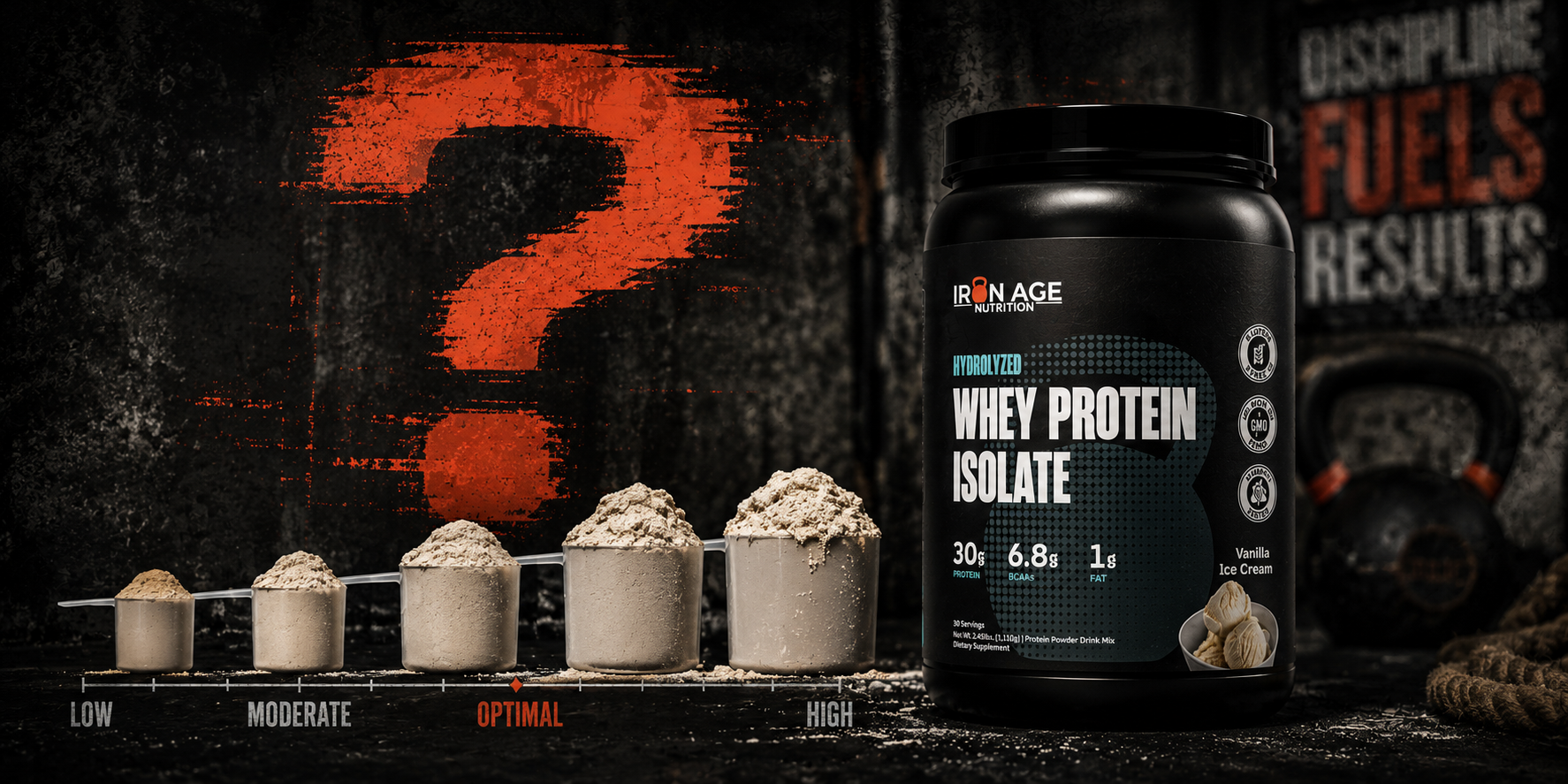
To build muscle, most people training with weights need roughly 1.6 to 2.2 grams of protein per kilogram of bodyweight per day — about 0.7 to 1.0 grams per pound. A 180 lb (82 kg) lifter lands near 130 to 180 grams daily. Below that range you leave gains on the table; above it, returns flatten fast.
That is the short answer. The rest of this guide explains where those numbers come from, how to split them across your day, whether timing actually matters, and what changes after age 40. No hype, just the research and the math.
How much protein do you need per day to build muscle?
The Recommended Dietary Allowance (RDA) is 0.8 g/kg per day. That number prevents deficiency in sedentary people. It was never meant to describe someone who trains hard and wants to add muscle.
For that goal, the International Society of Sports Nutrition (ISSN) position stand recommends 1.4 to 2.0 g/kg per day. A 2018 meta-analysis of 49 studies by Morton and colleagues found gains from added protein plateaued around 1.6 g/kg per day, with the confidence interval stretching to about 2.2 g/kg. In plain terms: 1.6 g/kg covers most people, and pushing toward 2.2 g/kg is the sensible ceiling if you are training hard or dieting.
Here is what that looks like by bodyweight and goal.
| Goal | Grams per kg / day | Grams per lb / day | 150 lb person | 200 lb person |
|---|---|---|---|---|
| General health (minimum) | 0.8 g/kg | 0.36 g/lb | ~55 g | ~73 g |
| Active / maintaining muscle | 1.2–1.6 g/kg | 0.55–0.73 g/lb | 82–109 g | 109–145 g |
| Building muscle | 1.6–2.2 g/kg | 0.73–1.0 g/lb | 109–150 g | 145–200 g |
| Cutting (preserve muscle in a deficit) | 2.0–2.4 g/kg | 0.9–1.1 g/lb | 136–164 g | 182–218 g |
Notice cutting sits highest. When calories drop, more protein protects lean mass and keeps you fuller. That is not a contradiction — it is the whole point.
Does it matter how you spread protein across the day?
Yes, more than most people think. Muscle protein synthesis — the process that rebuilds and grows muscle — responds to each protein feeding, then returns to baseline. Front-loading 150 grams into one dinner wastes the opportunity to trigger that response multiple times.
Research from Schoenfeld and Aragon suggests aiming for roughly 0.4 g/kg per meal across three to four meals to maximize the daily anabolic effect. For an 82 kg (180 lb) person that is about 30 to 35 grams per meal, three or four times a day.
The mechanism behind this is the leucine threshold. Leucine is the amino acid that flips the muscle-building switch, and each meal needs roughly 2.5 to 3 grams of it to do so fully. A 30-gram serving of a complete protein like whey, eggs, or lean meat clears that threshold comfortably. This is one reason a quality whey isolate — around 30 grams of protein and high in leucine per scoop — is such an efficient tool for hitting a per-meal target.
Does protein timing and the "anabolic window" really matter?
Not the way the old advice claimed. The idea that you must slam protein within 30 minutes of a workout or lose your gains does not hold up. A review by Aragon and Schoenfeld concluded the post-exercise window is far wider than once believed — on the order of several hours, not minutes.
What matters most is your total daily protein, hit consistently. Timing is a minor refinement on top of that. If you train fasted, having protein within a couple of hours afterward is reasonable. If you ate a normal meal beforehand, the amino acids are already circulating and there is no clock to beat.
Spend your effort hitting your daily number and spreading it across meals. That returns far more than obsessing over the minutes after your last set.
Do you need more protein after 40?
Likely yes. As we age, muscle becomes less responsive to a given dose of protein — a phenomenon called anabolic resistance. The same 20 grams that fully stimulated muscle protein synthesis at 25 does less at 65.
The PROT-AGE study group recommends 1.0 to 1.2 g/kg per day for healthy older adults, and 1.2 to 1.5 g/kg for those who are active or managing illness — well above the standard RDA. Just as important is the per-meal dose: older adults appear to need a larger single feeding, around 0.4 g/kg (roughly 30 to 40 grams), to fully trigger muscle building.
The practical takeaway for anyone over 40 who lifts: do not coast on the RDA. Keep total intake in the 1.2 to 1.6 g/kg range or higher, and make each meal count with a solid 30-plus gram hit of quality protein.
Whole foods vs. protein powder: which is better?
Whole foods win on nutrients. Chicken, eggs, fish, dairy, and legumes bring micronutrients, fiber, and satiety that a scoop of powder does not. Build your intake on real food first.
Powder is a convenience tool, not magic. It solves a real problem: hitting 150-plus grams a day from whole food alone takes planning, cooking, and appetite you may not have — especially around training or on busy days. A shake delivers 30 grams of complete protein in seconds, with a known dose and no prep.
Whey isolate is particularly efficient here: it is fast-digesting, high in leucine, and largely stripped of the lactose, fat, and carbs found in whole-milk sources. That makes it easy on digestion and easy to fit into a calorie target. Use it to fill the gaps your meals leave — not to replace them.
What are the most common protein myths?
Myth: "High protein damages your kidneys." In people with healthy kidneys, this is not supported. A 2018 meta-analysis found higher-protein diets did not harm kidney function in healthy adults. (People with existing kidney disease are a separate case and should follow medical guidance.)
Myth: "Your body can only absorb 30 grams of protein at a time." Your body absorbs nearly all the protein you eat — digestion is highly efficient. What has a practical ceiling is how much muscle protein synthesis a single meal maximally stimulates, which is why the per-meal target of ~0.4 g/kg exists. Eat 60 grams in one sitting and none of it is "wasted"; the excess is simply used for other functions or energy.
Myth: "More protein always equals more muscle." Past roughly 1.6 to 2.2 g/kg, extra protein does not add meaningful muscle. It becomes expensive fuel. Training stimulus, total calories, and consistency drive results once protein is adequate.
How to hit your protein number: a sample day
Here is a realistic day for a 180 lb (82 kg) lifter targeting about 160 grams — roughly 1.9 g/kg, squarely in the muscle-building range.
| Meal | Food | Protein |
|---|---|---|
| Breakfast | 3 eggs + 1 cup Greek yogurt | ~35 g |
| Lunch | 6 oz chicken breast + rice and veggies | ~45 g |
| Post-training shake | 1 scoop whey isolate | ~30 g |
| Dinner | 6 oz salmon or lean beef | ~40 g |
| Total | ~150 g | |
Four feedings, each clearing the leucine threshold, spread across the day. Add a snack — cottage cheese, a second scoop, jerky — if you need to close the gap to your target.
Key takeaways
- Target 1.6–2.2 g/kg (0.7–1.0 g/lb) per day to build muscle. Most people are covered near 1.6 g/kg.
- Spread it across 3–4 meals of ~0.4 g/kg each to trigger muscle protein synthesis repeatedly.
- Each meal needs ~2.5–3 g leucine — a 30 g serving of complete protein clears it.
- Timing is minor. The anabolic window is hours, not minutes. Daily total is what counts.
- After 40, go higher (1.2–1.6 g/kg) to overcome anabolic resistance.
- Protein does not harm healthy kidneys, and your body absorbs more than 30 g per meal.
- Whole food first; powder for convenience. Whey isolate is an efficient gap-filler, not a shortcut.
Where a clean protein source fits
Once you know your number, the job is hitting it consistently with protein you trust. That is the whole reason we formulate Iron Age Whey Protein Isolate the way we do: 30 grams of 100% whey isolate per serving, no fillers, no artificial sweeteners, and virtually lactose free — so a scoop reliably clears your per-meal target without the digestive baggage. It is third-party tested with a certificate of analysis available on request. Real food builds the base; a clean isolate closes the gap. If you want the deeper dive on why isolate is a clean recovery tool, read our guide to whey isolate as clean fuel for muscle recovery.
Frequently asked questions
How much protein do I need to build muscle per pound?
Aim for roughly 0.7 to 1.0 grams of protein per pound of bodyweight per day. For a 175 lb person that is about 125 to 175 grams daily. Most people build muscle effectively near the lower end of that range as long as intake is consistent and training is progressive.
Is 100 grams of protein a day enough to build muscle?
It depends on your bodyweight. For someone around 140 lb (64 kg), 100 grams meets the muscle-building range. For a 200 lb (91 kg) person, 100 grams falls short — they would want roughly 145 to 200 grams per day. Match the amount to your weight and goal.
Can I build muscle without protein powder?
Absolutely. Powder is a convenience, not a requirement. Chicken, eggs, fish, dairy, and legumes can cover your entire target. Powder simply makes hitting a high number easier when appetite, time, or a calorie budget makes whole food impractical — for example around training.
Does eating more than 30 grams of protein in one meal go to waste?
No. Your body absorbs nearly all the protein you eat. The "30 gram" idea refers to how much muscle-building a single meal maximally stimulates, not absorption. Larger meals are still used — for other tissues, functions, or energy — nothing is discarded.
Does high protein hurt your kidneys?
In people with healthy kidneys, current research does not show harm from higher-protein diets. A 2018 meta-analysis found no adverse effect on kidney function in healthy adults. Those with existing kidney disease are a different case and should follow their doctor's guidance.
Do older adults need more protein?
Yes. Aging brings anabolic resistance, so muscle responds less to a given dose. Healthy older adults benefit from 1.0 to 1.2 g/kg per day, and active ones from 1.2 to 1.5 g/kg — above the standard RDA — with larger per-meal servings of around 30 to 40 grams.
Share:
Whey Isolate vs. Concentrate: What's the Difference and Which Should You Buy?
Why Do I Keep Getting Muscle Cramps? Causes and What Actually Helps