
Electrolytes are charged minerals—sodium, potassium, magnesium, chloride, and calcium—that carry the electrical signals behind muscle contraction, nerve firing, and fluid balance. You lose them mostly through sweat. During hard or hot training you can lose over 1 gram of sodium per hour, which plain water alone does not replace.
Most people hear "electrolytes" and picture a neon sports drink. That is marketing, not physiology. This guide covers what these minerals actually do, how much you need, how much you lose when you sweat, why water alone can sometimes backfire, and what separates a serious electrolyte formula from a sugar-loaded one.
What are electrolytes and what do they actually do?
Electrolytes are minerals that carry an electrical charge when dissolved in your body's fluids. That charge is not a metaphor. Your nervous system and muscles run on tiny voltage changes, and those changes depend on minerals moving in and out of cells.
According to the Cleveland Clinic, electrolytes regulate nerve and muscle function, hydration, blood pH, and blood pressure. When they drop too low or climb too high, things stop working smoothly—cramps, fatigue, brain fog, and worse.
Here is what each major electrolyte does.
| Electrolyte | Primary role | What happens when it's low |
|---|---|---|
| Sodium | Governs fluid balance and blood volume; drives nerve signals. The main electrolyte lost in sweat. | Headache, nausea, muscle cramps, dizziness, poor performance. |
| Potassium | Works with sodium to fire nerves and contract muscles, including the heart. | Weakness, cramps, irregular heartbeat. |
| Magnesium | Cofactor in over 300 enzyme reactions, including energy production and muscle relaxation. | Muscle twitches, cramps, fatigue, poor sleep. |
| Chloride | Partners with sodium for fluid balance and stomach acid production. | Usually tracks sodium loss; imbalance affects blood pH. |
| Calcium | Triggers the actual muscle contraction and supports nerve signaling and bone. | Numbness, tingling, muscle spasms. |
Notice the theme: nerves and muscles. When you cramp, fade, or feel wobbly late in a session, an electrolyte shortfall is often part of the story—though rarely the whole story.
What are the signs of an electrolyte imbalance?
An imbalance means a mineral is too low or too high relative to your body's fluid. For active people, the common direction is low, driven by heavy sweating without replacement.
Early, mild signs include:
- Muscle cramps or twitching
- Fatigue that hits earlier than expected
- Headache and dizziness
- Nausea or loss of appetite
- Brain fog and irritability
These symptoms overlap with plain dehydration, which makes sense—you usually lose fluid and sodium together. Severe imbalances can cause confusion, fainting, or heart rhythm problems and need medical attention, not a stick pack. If symptoms are severe or persistent, see a doctor.
How much sodium do you actually lose in sweat?
This is where the numbers matter, because sodium is the electrolyte you lose in the largest amounts. Two variables decide your losses: how much you sweat, and how salty that sweat is.
Sweat rates vary widely by sport, body size, intensity, and heat. Normative data compiled by the Gatorade Sports Science Institute show average whole-body sweat rates around 1.3 L/h in endurance athletes and 1.5 L/h in American football players, with plenty of individuals above 2 L/h in heat.
Sweat sodium concentration also varies a lot between people. A review of sweat testing methodology reports typical sweat sodium in the range of roughly 20 to 80 mmol/L. Since 1 mmol of sodium is about 23 mg, that works out to roughly 460 to 1,840 mg of sodium per liter of sweat.
Put those together and the picture is clear.
| Scenario | Sweat rate | Sweat sodium | Approx. sodium lost per hour |
|---|---|---|---|
| Light indoor session | 0.5 L/h | Low (~30 mmol/L) | ~345 mg |
| Typical endurance training | 1.3 L/h | Average (~40 mmol/L) | ~1,200 mg |
| "Salty sweater" in the heat | 1.8 L/h | High (~70 mmol/L) | ~2,900 mg |
The GSSI data back this up: measured sodium loss rates averaged around 52 mmol/h in endurance athletes—roughly 1,200 mg of sodium per hour. A long training day can therefore cost you several grams of sodium. That is the number most hydration advice ignores.
How do you estimate your own sweat rate?
Averages are a starting point, but your losses are personal. You can measure your own sweat rate at home with a scale, no lab required.
- Weigh yourself with minimal clothing right before a workout.
- Train for one hour at your usual intensity, noting how much fluid you drink in ounces.
- Towel off and weigh yourself again in the same clothing.
- Convert weight lost to fluid: each pound lost equals about 16 ounces of sweat. Add back any fluid you drank.
For example: you lose 2 pounds (32 oz) and drank 16 oz of water. Your sweat rate is roughly 48 oz—about 1.4 liters—per hour. That tells you how much fluid to aim to replace. Combine it with the salt-crust test (visible white residue means high sodium losses) and you have a rough but useful picture of your hourly needs. Repeat it in different conditions, because heat and intensity change the result.
Two rules of thumb round this out. Losing more than about 2% of your body weight in fluid during a session is where performance and focus tend to slip. And you rarely need to replace fluid ounce-for-ounce during the workout itself—drinking to thirst plus sodium is usually enough, with the rest replaced afterward.
Why isn't plain water enough?
Water replaces volume. It does not replace minerals. When you sweat out sodium and then drink only water, you dilute the sodium that remains in your blood. In most everyday situations your kidneys handle this easily. In prolonged, heavy-sweating exercise, it can become a problem.
That problem has a name: exercise-associated hyponatremia (EAH), meaning abnormally low blood sodium during or after exercise. The international consensus on EAH identifies the primary cause as drinking fluid—usually plain water—in excess of sweat losses, which dilutes blood sodium.
To be clear and non-alarmist: EAH is relatively uncommon and is mostly documented in endurance events like marathons and ultramarathons, where athletes overdrink for hours. It is not a reason to fear water. It is a reason to understand that during long or hot efforts, replacing sodium alongside fluid keeps your balance where it should be. The takeaway is not "drink less water." It is "when you sweat hard for a long time, water alone is only half the equation."
How much of each electrolyte do you need per day?
Baseline daily needs come from established reference intakes for the general adult population. These are starting points from a normal diet—before you account for sweat.
| Electrolyte | General adult daily target | Source |
|---|---|---|
| Sodium | Adequate Intake 1,500 mg; chronic-disease reduction target under 2,300 mg | Dietary Reference Intakes |
| Chloride | Adequate Intake ~2,300 mg (ages 19–50) | Dietary Reference Intakes |
| Potassium | 3,400 mg (men), 2,600 mg (women) | NIH Office of Dietary Supplements |
| Magnesium | 400–420 mg (men), 310–320 mg (women) | NIH Office of Dietary Supplements |
| Calcium | 1,000 mg (most adults); 1,200 mg (women 51+) | Dietary Reference Intakes |
Two things worth flagging. First, the NIH notes that many Americans fall short of recommended potassium and magnesium intakes from food alone. Second, these baselines assume a resting person. The moment you start sweating heavily, your sodium needs can climb well above the daily target within a single session.
When do your needs go up?
Certain situations sharply increase electrolyte demand—especially sodium:
- Heavy or prolonged training: more sweat, more sodium out.
- Heat and humidity: sweat rates can double.
- "Salty sweaters": if your skin or clothes show white salt crust, your losses are on the high end.
- Fasting: low insulin makes the kidneys excrete more sodium, so fasted people often need extra.
- Low-carb and keto diets: the same insulin effect flushes sodium, water, and potassium, which is why "keto flu" symptoms respond to added electrolytes.
- Illness: vomiting and diarrhea drain electrolytes fast (rehydration for illness is a medical topic—follow clinical guidance).
Can you get electrolytes from food instead of supplements?
Often, yes—and you should build the base from food. Whole foods deliver electrolytes alongside other nutrients your body uses.
| Electrolyte | Strong food sources |
|---|---|
| Sodium | Table and sea salt, broth, pickles, olives, cured meats |
| Potassium | Potatoes, bananas, beans, leafy greens, yogurt, avocado |
| Magnesium | Pumpkin seeds, almonds, spinach, black beans, dark chocolate |
| Calcium | Dairy, fortified plant milks, sardines, tofu, leafy greens |
The gap shows up around training. If you sweat out 1,000–2,000 mg of sodium in an hour, you are not going to conveniently eat that back mid-workout. That is the practical case for a supplement: fast, measured replacement of what sweat took, without stopping to prep a meal. Food builds the foundation; a good electrolyte covers the acute losses.
What should you look for in an electrolyte product?
This is where most products fail. The label matters more than the marketing. Here is a clean checklist—and the red flags to avoid.
What a serious formula gets right
- Meaningful sodium: if you are using it around exercise, look for a genuinely useful dose, not a token 100 mg. Sweat losses are measured in the hundreds to thousands of milligrams.
- A real mineral base: where the sodium comes from matters. Celtic Sea Salt delivers sodium alongside more than 72 naturally occurring trace minerals, rather than isolated, refined sodium chloride.
- Potassium and magnesium included: the two minerals most people under-consume.
- Transparency: third-party testing, a Certificate of Analysis available on request, and manufacturing in an FDA-registered facility.
Red flags to avoid
- Sugar-loaded mixes: many "sports drinks" are mostly sugar water with a pinch of sodium. Fine as fuel; poor as an electrolyte.
- Artificial sweeteners, colors, and preservatives: unnecessary additives that do nothing for hydration.
- Underdosed "electrolyte" claims: a formula that lists five minerals but supplies trace amounts of each.
- Vague labels: "electrolyte blend" with no per-mineral amounts.
If you want to go deeper on why the sodium source matters, we broke it down here: why Celtic Sea Salt is a superior clean source of essential minerals. And if you are wondering about the sweeteners many brands use, this is worth reading: is stevia bad for you, what the science really says.
Does everyone need an electrolyte supplement?
No—and we would rather tell you that than sell you something you do not need. If you are sedentary, eat a varied diet, and sweat lightly, food and water cover your needs. Reaching for electrolytes on a couch day is not doing much.
The people who genuinely benefit are the ones losing minerals faster than a normal diet replaces them: endurance and team-sport athletes, anyone training hard in heat, heavy or salty sweaters, people who fast or eat low-carb, and those working physical jobs outdoors. If that is you, a clean electrolyte is a tool, not a luxury. If it is not you, save your money for the days it matters.
The mistake in both directions is the same—ignoring your actual losses. Some people under-replace and pay for it with cramps and fade. Others dump electrolytes into every glass of water out of habit. Match intake to what you lose, and you will get it right most of the time.
When should you take electrolytes?
Timing is simple once you know your losses. Match intake to the situations that drain you.
- Before: a stick pack 15–30 minutes before a hot or long session tops off your reserves.
- During: for efforts over about 60–90 minutes, or shorter sessions in serious heat, sip electrolytes with your water rather than water alone.
- After: replace what you lost, especially if you finished salt-crusted or crushed a hard, sweaty session.
- Non-training use: first thing in the morning, while fasting, on low-carb days, or when traveling and under-hydrated.
Where Total Hydrate fits
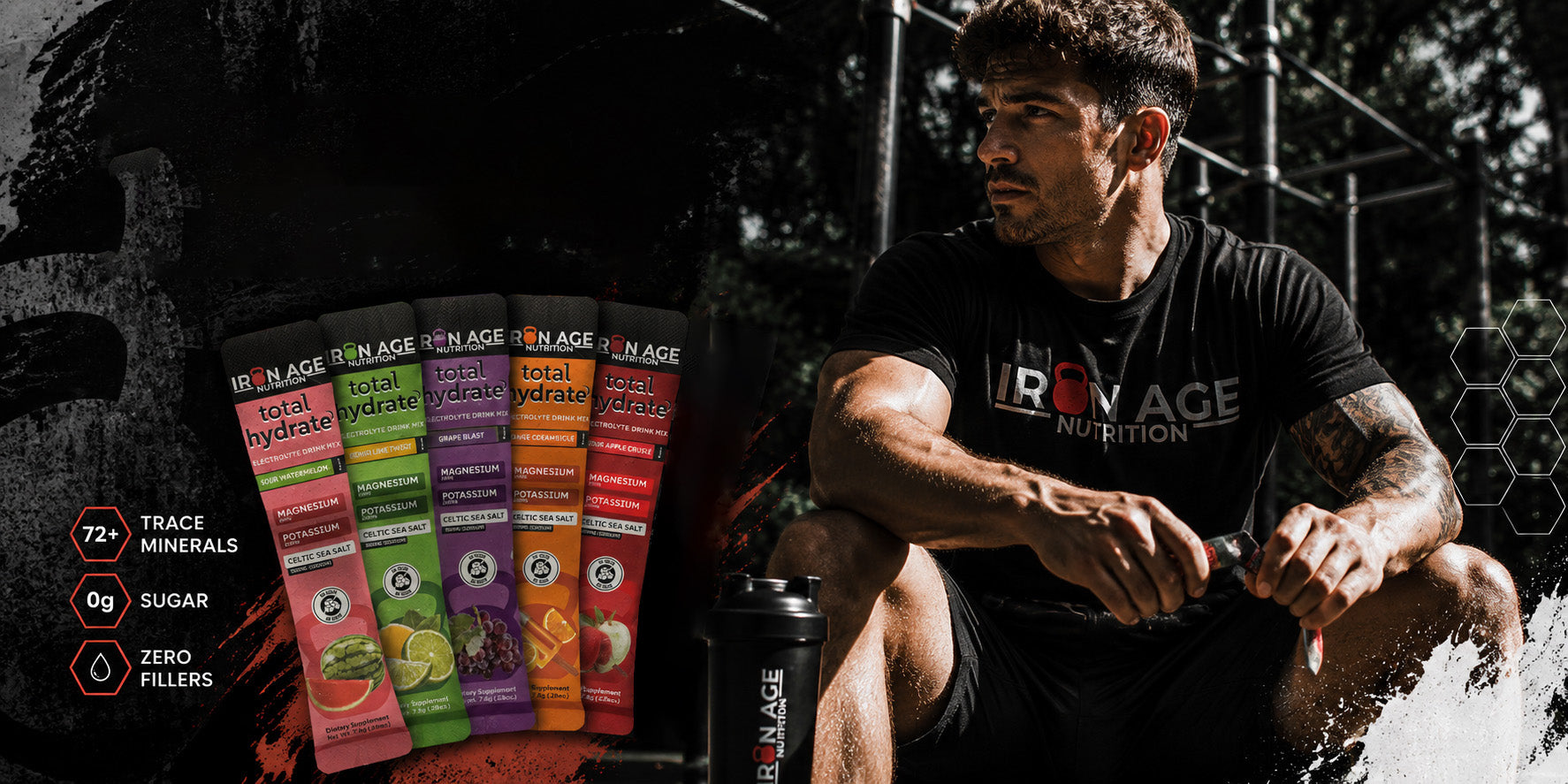
Iron Age built Total Hydrate™ around the checklist above rather than around a flavor gimmick. It uses a Celtic Sea Salt base for sodium plus more than 72 naturally occurring trace minerals, with zero sugar, zero artificial sweeteners, zero artificial colors, and zero preservatives. It is naturally flavored, made in the USA in an FDA-registered facility, and third-party tested with a Certificate of Analysis available on request.
That is the point of this whole guide: an electrolyte should replace what sweat takes, cleanly and in doses that actually match your losses. Feel Great, Elevate, Dominate. Twelve stick packs run $21.99, and 24 run $35.99—in five naturally flavored options.
Key takeaways
- Electrolytes—sodium, potassium, magnesium, chloride, calcium—power nerve signals, muscle contraction, and fluid balance.
- Sodium is the electrolyte you lose most in sweat: often 1,000–2,000+ mg per hour during hard or hot training.
- Water replaces fluid, not minerals. Over long, heavy-sweating efforts, drinking only water can dilute blood sodium.
- Baseline daily targets exist, but training, heat, fasting, and low-carb diets push sodium needs higher.
- Build the foundation with food; use a clean, properly dosed supplement to cover acute sweat losses.
- Avoid sugar-loaded, artificially sweetened, or underdosed "electrolyte" products.
Frequently asked questions
Do I need electrolytes if I only work out for 30 minutes?
For a short, moderate session in a cool environment, water and a normal diet usually cover it. Electrolytes earn their place when sessions run long (roughly 60+ minutes), when it is hot and humid, when you sweat heavily, or when you train fasted or on a low-carb diet. Match intake to how much you actually sweat.
Can you take too many electrolytes?
Yes. More is not better. Excess sodium is a concern for people with high blood pressure or kidney issues, and very high potassium or magnesium doses can cause problems. Aim to replace what you lose, not to overload. If you have a medical condition, talk to your doctor before adding a high-sodium supplement.
Are sugar-free electrolytes better than sports drinks?
For hydration specifically, yes. Traditional sports drinks are mostly sugar with a little sodium, designed as fuel. A sugar-free electrolyte gives you the minerals without the added sugar and calories. If you also need carbohydrate fuel for a long endurance effort, that is a separate decision from electrolyte replacement.
What makes Celtic Sea Salt different from regular table salt?
Regular table salt is refined down to sodium chloride. Celtic Sea Salt is minimally processed and retains more than 72 naturally occurring trace minerals alongside its sodium. Both deliver sodium, but the Celtic Sea Salt base brings additional trace minerals and skips the anti-caking additives found in many refined salts.
Is exercise-associated hyponatremia something I should worry about?
For most people, no—it is relatively uncommon and mainly seen in endurance events where athletes overdrink water for hours. The practical lesson is simple: during long or hot efforts, replace sodium along with fluid instead of chugging plain water. Do not drink far beyond thirst, and include electrolytes on big sweat days.
How much sodium should I put in my water during exercise?
It depends on your sweat rate and how salty your sweat is, which vary a lot between people. A common practical range is 300–700 mg of sodium per hour of hard exercise, more for heavy or salty sweaters in heat. Start on the lower end, notice how you feel and perform, and adjust.
Share:
Is Stevia Bad for You? What the Science Really Says
Do Electrolytes Break a Fast?