

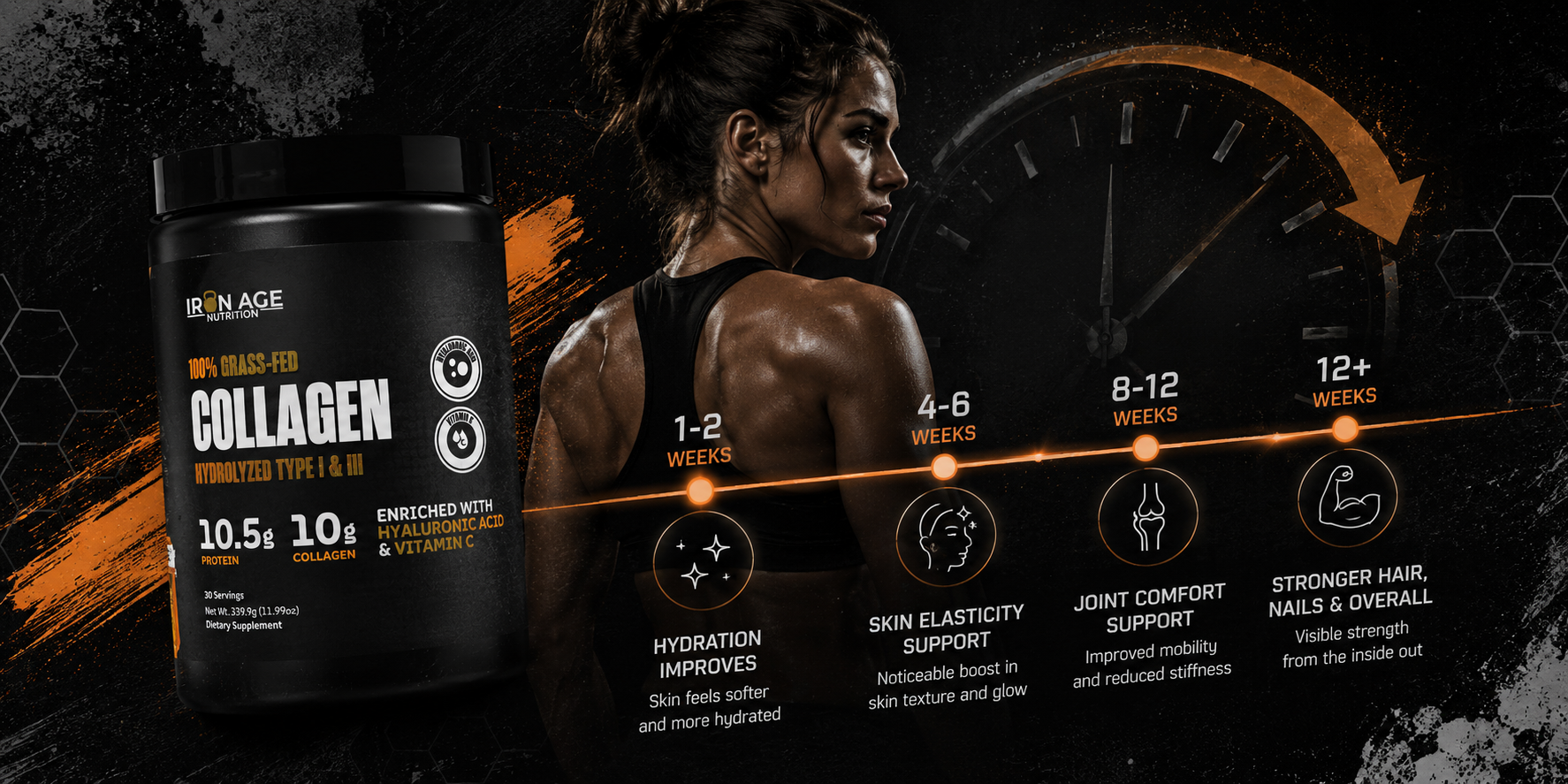
Most people see the first real results from collagen in 8 to 12 weeks, not days. Skin hydration and elasticity respond first (around 8 to 12 weeks). Joint comfort takes longer, roughly 12 to 24 weeks. Hair and nails are slowest, near 24 weeks. Consistency and dose matter more than the brand on the tub.
Collagen is not a stimulant. You will not feel it kick in. It works by giving your body the raw peptides it uses to rebuild connective tissue, and tissue turnover runs on biological time, not marketing time. Below is what the clinical trials actually found, sorted by the outcome you care about.
How long does collagen take to work, by outcome?
Different tissues rebuild at different speeds. Skin has a fast cellular turnover. Cartilage and hair follicles are slow. That is why a single "collagen works in X weeks" number is misleading. Here is the research-backed breakdown.
| Outcome | Realistic timeline | What the research shows |
|---|---|---|
| Skin hydration & elasticity | 8–12 weeks | 2.5 g/day for 12 weeks raised skin hydration ~28% and improved elasticity and density vs. placebo. |
| Wrinkle depth / roughness | 8–12 weeks | Same trial: wrinkle depth dropped ~27% at 12 weeks and effects held 4 weeks after stopping. |
| Joint comfort (active people) | 12–24 weeks | 5 g/day for 12 weeks reduced activity-related knee discomfort vs. placebo in athletes. |
| Nail growth & brittleness | ~24 weeks | 2.5 g/day for 24 weeks increased nail growth ~12% and cut breakage ~42%. |
| Hair thickness | ~24 weeks | Follicle cycles are long; give it a full growth phase before judging. |
The pattern is simple. If you start today, expect skin feedback around the two- to three-month mark and joint or nail feedback closer to the six-month mark. Anyone promising a visible change in a week is selling, not coaching.
Why do hydrolyzed collagen peptides matter for absorption?
Whole collagen is a huge, tightly wound protein. Your gut cannot absorb it intact. "Hydrolyzed" means the collagen has been enzymatically cut into short peptides, small enough to cross the intestinal wall.
In a randomized crossover study, researchers detected collagen-specific peptides like hydroxyproline in the bloodstream within about an hour of ingestion, confirming these fragments survive digestion and circulate (Frontiers in Nutrition, 2024). Those circulating peptides appear to signal fibroblasts, the cells that build new collagen, to get to work.
This is why form matters. Unhydrolyzed "collagen protein" or gelatin is harder to absorb efficiently. Iron Age Hydrolyzed Collagen uses Type I & III grass-fed bovine peptides that are already broken down for uptake, unflavored and odorless so you can add the full dose to coffee or water without additives getting in the way.
What is the effective daily dose of collagen?
Dose depends on your goal. The trials that produced results clustered in a narrow, unglamorous range. More is not automatically better, but under-dosing is the most common reason people see nothing.
- Skin (hydration, elasticity, wrinkles): 2.5–5 g/day. The 2.5 g skin study still hit strong results.
- Joints and connective tissue: 5–10 g/day, taken consistently over months.
- Nails and general connective support: 2.5–5 g/day.
- Muscle and recovery contexts: up to 15 g/day is used in athletic protocols.
One Iron Age serving delivers a full research-aligned dose for skin, nail, and everyday joint support, which is why we price it at $34.99 for 30 servings ($1.17 a serving). Precision on the dose beats hype on the label.
Type I & III vs. Type II collagen: which do you need?
Your body makes at least 28 types of collagen. Three matter for supplements. Type I is the dominant protein in skin, tendons, bone, and nails. Type III sits alongside it in skin and blood vessels. Type II is concentrated in cartilage.
For skin, hair, nails, and general connective tissue, you want Type I & III, which is what bovine hydrolyzed collagen provides. Type II (usually from chicken cartilage) is a specialized ingredient studied mainly for cartilage-specific support and is dosed very differently, often as tiny "undenatured" amounts. For the outcomes most people chase, Type I & III is the workhorse. Our deeper breakdown of the two lives here: Collagen Types 1 and 3 explained.
What speeds up or slows down collagen results?
The timeline above assumes you do the basics right. These variables move it.
Speeds it up:
- Consistency. Daily dosing is the single biggest factor. Skipping days resets your progress. Tissue rebuilds on a steady supply, not sporadic spikes.
- Vitamin C. Your body cannot synthesize collagen without vitamin C as a cofactor for the enzymes that stabilize the collagen structure (NIH Office of Dietary Supplements). Pair your collagen with a vitamin C source.
- Adequate protein and sleep. Collagen synthesis is repair work; it needs building blocks and recovery time.
Slows it down:
- Age. Natural collagen production declines after roughly age 25, so older skin has more ground to make up.
- Sun exposure and smoking. Both degrade existing collagen and blunt new synthesis. You can out-supplement neither.
- High sugar intake. Excess sugar can damage collagen fibers through glycation.
What are the signs collagen is working?
Because collagen builds quietly, watch for subtle, cumulative signals rather than a dramatic switch.
- Skin that feels more hydrated and "bouncy" (elasticity) around weeks 8–12.
- Nails that chip and split less, and grow faster, by months four to six.
- Less day-to-day joint stiffness after activity, emerging over months three to six.
- Smoother skin texture and softer fine lines with continued use.
Take a baseline photo and note your starting nail breakage and joint comfort. Memory is a poor measuring tool over 12 weeks; a photo is not.
When should you keep going vs. give up?
Give any collagen protocol a fair trial: a minimum of 8 weeks for skin and a full 12 to 24 weeks for joints, hair, and nails, at an adequate daily dose, with vitamin C. Judging collagen at two weeks is like judging a training program after one workout.
If you have been consistent at 5–10 g/day for a full six months with vitamin C and genuinely see no change in skin, nails, or comfort, it is reasonable to stop. Also worth checking: were you actually consistent, and was the dose high enough? Under-dosing and skipped days explain most "it didn't work" verdicts. Persistent joint pain is a reason to see a clinician, not to keep guessing with a supplement.
Key takeaways
- Realistic timelines: skin 8–12 weeks, joints 12–24 weeks, hair and nails ~24 weeks.
- Hydrolyzed peptides absorb into the bloodstream within about an hour; whole collagen and gelatin do not absorb as efficiently.
- Effective doses: 2.5–5 g/day for skin and nails, 5–10 g/day for joints, up to 15 g in athletic protocols.
- Use Type I & III for skin, hair, nails, and general connective tissue.
- Consistency and vitamin C speed results; age, sun, and smoking slow them.
- Give it a full 8–24 week trial before deciding it does or doesn't work.
Frequently asked questions
Can you see collagen results in 2 weeks?
Realistically, no. Some people report smoother skin feel early, but measurable changes in hydration and elasticity took about 8 to 12 weeks in controlled trials. Joints and nails take longer still. Two weeks is not enough time for connective tissue to rebuild, so judge the results at the two- to three-month mark, not sooner.
What is the best time of day to take collagen?
Timing has little effect on results; consistency does. Take it whenever you will actually remember it every day, whether that is morning coffee or an evening drink. Unflavored, odorless hydrolyzed collagen mixes into hot or cold liquids without changing taste, which makes a daily habit easier to keep for the full timeline.
Do I need to take collagen with vitamin C?
It helps. Vitamin C is a required cofactor for the enzymes that build stable collagen in your body, so pairing the two supports synthesis. Many people already get enough vitamin C from diet, but taking your collagen alongside fruit, vegetables, or a vitamin C source is a simple way to cover the base.
How much collagen should I take per day?
Match the dose to your goal: 2.5 to 5 grams a day for skin and nails, and 5 to 10 grams a day for joint and connective-tissue support. Athletic recovery protocols use up to 15 grams. Under-dosing is the most common reason people see no results, so hit a research-aligned amount consistently.
Is bovine collagen better than marine collagen?
Neither is universally "better." Grass-fed bovine collagen provides Type I & III, ideal for skin, hair, nails, and general connective tissue. Marine collagen is mostly Type I and absorbs well but costs more. For most goals, Type I & III bovine peptides deliver the broadest support at a lower cost per serving.
Will collagen results disappear if I stop taking it?
Gains fade gradually once you stop, since your body returns to its baseline production rate, which declines with age. In one skin study, improvements were largely retained four weeks after stopping, but long-term benefits depend on continued use. Treat collagen as an ongoing habit, not a short course.
The Iron Age approach
We built Iron Age Hydrolyzed Collagen for the person who reads the label. Type I & III, grass-fed bovine, hydrolyzed for absorption, unflavored and odorless, with zero additives, made in an FDA-registered facility and third-party tested with a COA available on request. One serving is a full research-aligned dose at $1.17. No overnight promises. Just clean peptides, an honest timeline, and the consistency that actually delivers. Feel Great, Elevate, Dominate.
Share:
Do Electrolytes Break a Fast?
Whey Isolate vs. Concentrate: What's the Difference and Which Should You Buy?