
For workouts lasting longer than 60 to 90 minutes, sodium per serving is the number that decides whether an electrolyte drink works. LMNT leads the category at 1,000 mg of sodium per stick, followed by Iron Age Total Hydrate™ at 800 mg. Pedialyte Sport (650 mg), Liquid I.V. (510 mg), and Gatorlyte (490 mg) sit in the middle. Nuun Sport (300 mg) and Ultima Replenisher (55 mg) are built for lighter use. Match the sodium to how much you actually sweat — not to the brand on the packet.
Most "best electrolyte" lists rank by taste and packaging. For a long session that is the wrong criterion. What matters is whether the powder replaces what left your body, and most of what leaves your body in sweat is sodium. Here is the comparison on the numbers, including where our own product does and does not fit.
How much sodium do you actually lose during a long workout?
More than most electrolyte packets replace, and the range between people is enormous.
The National Athletic Trainers' Association position statement on fluid replacement puts sweat sodium concentration at 10 to 100 mEq/L — roughly 230 to 2,300 mg of sodium per liter of sweat — and sweat rate at 0.5 to 4.0 L per hour. NATA classifies a "salty sweater" as above 60 mEq/L (about 1,380 mg/L) and a heavy sweater as above 2.5 L/hour.
Run the math on the extremes. A light sweater at 0.5 L/hour and 230 mg/L loses about 115 mg of sodium in an hour. A heavy, salty sweater at 2.5 L/hour and 1,500 mg/L loses about 3,750 mg in the same hour. Same workout, a thirty-fold difference in need. This is why no single product is correct for everyone, and why any brand claiming one packet suits every athlete is not being straight with you.
NATA also notes that exercise lasting longer than one hour, or including intense intervals, may benefit from added carbohydrates or electrolytes or both. Under an hour at moderate intensity, water is usually fine.
For genuinely long efforts, the ISSN position stand on single-stage ultra-marathon recommends 450–750 mL of fluid per hour and 30–50 g of carbohydrate per hour, and observes that commercial sports drinks typically deliver only 460–575 mg of sodium per liter — concentrations the authors describe as potentially lower than ultra-endurance needs.
What should you look for in an electrolyte for long sessions?
Five things, in this order:
- Sodium first. It is the electrolyte lost in the largest quantity by a wide margin, and the one most linked to performance and cramping in heavy sweaters.
- Potassium and magnesium second. Real but much smaller losses. Useful for a complete formula, not the deciding factor.
- Carbohydrate concentration, if any. A 2024 review in Nutrients reports that carbohydrate concentrations above 6% slow fluid delivery compared with water, and that fluid absorption is impaired above roughly 350 mOsm/kg. A 2022 meta-analysis in Sports Medicine covering 28 studies found hypotonic drinks (under 275 mOsmol/kg) preserved plasma volume better than isotonic, hypertonic, or plain water.
- Magnesium form and dose. The NIH Office of Dietary Supplements notes that magnesium carbonate, chloride, gluconate, and oxide are the forms most commonly reported to cause diarrhea, and that the tolerable upper intake for supplemental magnesium in adults is 350 mg per day. A large magnesium dose mid-run is a risk, not a feature.
- Whether you will actually drink it. The best-formulated powder you leave in the cupboard replaces nothing.
Electrolyte powders compared
| Brand | Sodium | Potassium | Magnesium | Sugar | Sweetener | $/serving |
|---|---|---|---|---|---|---|
| LMNT Recharge | 1,000 mg | 200 mg | 60 mg (malate) | 0 g | Stevia | $1.50 |
| Iron Age Total Hydrate™ | 800 mg (from Celtic Sea Salt) | 250 mg | 65 mg (citrate) | 0 g | Stevia leaf extract | $1.50–$1.83 |
| Pedialyte Sport | 650 mg | 600 mg | 55 mg | 7 g | Sucralose + acesulfame K | $2.00 |
| Liquid I.V. Hydration Multiplier | 510 mg | 390 mg | None | 11 g total | Cane sugar, dextrose, stevia | $1.56 |
| Gatorlyte | 490 mg | 350 mg | 105 mg | 10 g total | Sugar | $1.33 |
| Skratch Labs Sport Hydration | 400 mg | 80 mg | 80 mg (carbonate) | 18–19 g total | Cane sugar, dextrose | $1.20 |
| Nuun Sport (tablet) | 300 mg | 150 mg | 25 mg | 1 g | Stevia | $0.75 |
| Ultima Replenisher | 55 mg | 250 mg | 100 mg (citrate) | 0 g | Stevia | $0.73 |
Figures taken from each brand's published label or product page, July 2026. Where a label reported only total sugars rather than added sugars, total sugars are shown. Formulations change — check the packet you buy.
Best for the highest sodium: LMNT
At 1,000 mg of sodium per stick with zero sugar, LMNT is the highest-sodium mainstream option and the most defensible choice for a heavy, salty sweater on a multi-hour effort in heat. It is also the one most likely to taste aggressively salty if your losses are modest — that dose is genuinely a lot for a 45-minute gym session. Credit where it is due: they picked a lane and formulated for it honestly.
Best if you want carbohydrate with your electrolytes: Skratch or Gatorlyte
For efforts past about two hours, carbohydrate is not padding — it is fuel, and the ISSN ultra-endurance stand calls for 30–50 g per hour. Skratch Labs Sport Hydration (18–19 g of sugar, 400 mg sodium) and Gatorlyte (10 g sugar, 490 mg sodium, 350 mg potassium) both deliver carbohydrate alongside minerals from real sugar rather than artificial sweeteners. If you are riding for four hours, a sugar-free electrolyte alone will not fuel you and you will need calories from somewhere.
Cheapest per serving: Nuun and Ultima
Nuun Sport at $0.75 and Ultima Replenisher at $0.73 per serving are the value picks. Both are lightly dosed on sodium — 300 mg and 55 mg respectively. Ultima in particular is a low-sodium, magnesium-forward formula; at 55 mg of sodium it is not a serious long-workout sodium replacer, whatever else it does well. Know what you are buying.
Where Total Hydrate fits — and where it doesn't
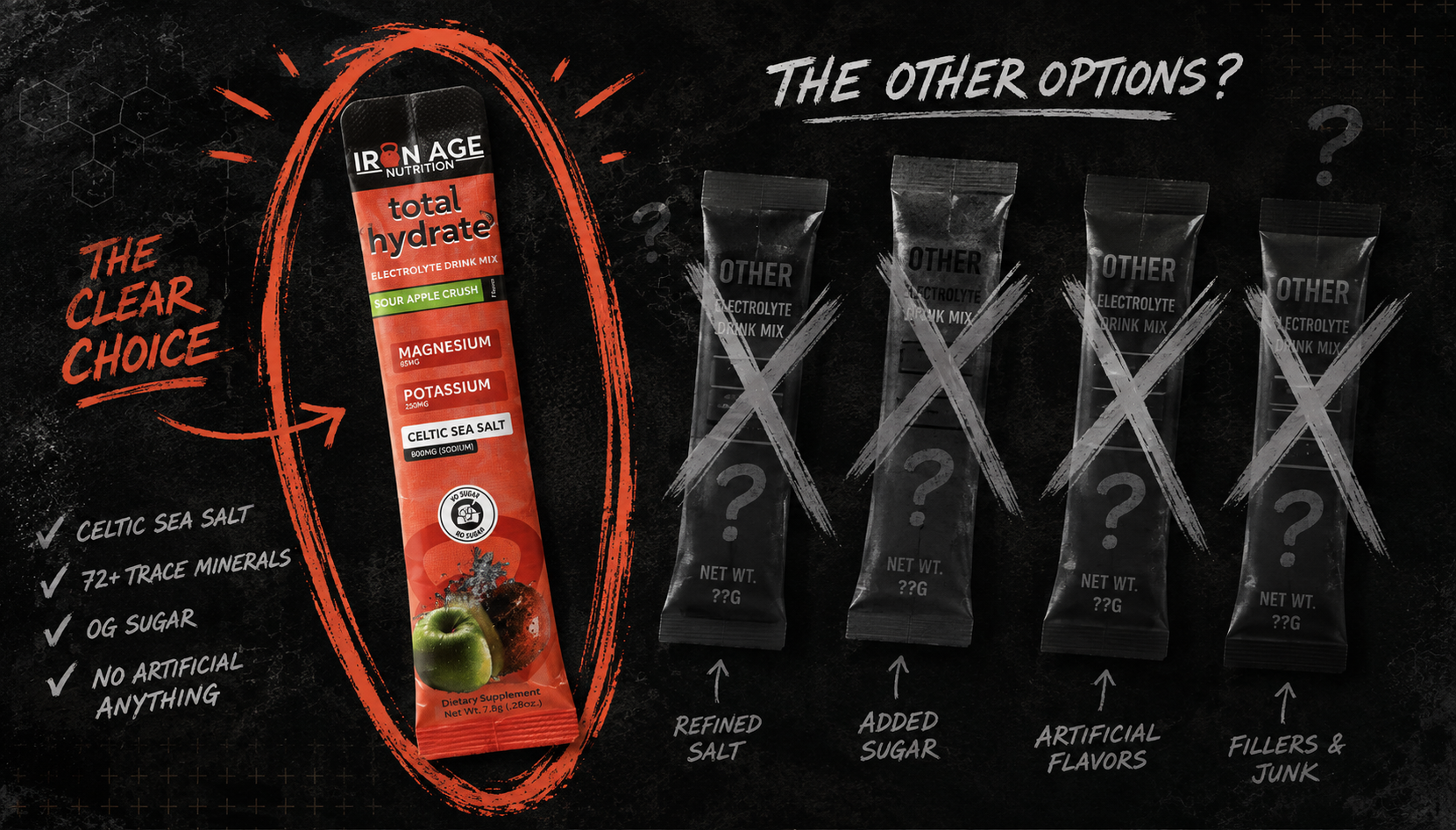
Total Hydrate™ delivers 800 mg of sodium per stick — 35% of the Daily Value — sourced from Celtic Sea Salt rather than plain sodium chloride, plus 250 mg potassium as potassium citrate, 65 mg magnesium citrate, 20 mg calcium, and 1,000 mg chloride. That places it second only to LMNT on sodium among the powders here, and ahead of every sugar-sweetened option on the list. Zero sugar, zero artificial sweeteners, zero dyes, sweetened with stevia leaf extract. Magnesium sits at a modest 65 mg in citrate form — well clear of the dose range where magnesium becomes a mid-run gastrointestinal problem. Every batch is third-party tested and the certificate of analysis is available on request.
The honest limitation: it contains no carbohydrate at all. Past roughly two hours you need fuel as well as minerals — 30 to 50 g of carbohydrate per hour — and Total Hydrate provides none of it, so you will need gels, chews, or food alongside. The other caveat runs the opposite direction: 800 mg is a substantial sodium dose, and if you are a light sweater doing 45 minutes indoors, half a stick in a full bottle is plenty. More sodium is not automatically better, ours included.
Where it is the right pick: you want a high-sodium, mineral-dense hydration without sugar, sucralose, or Red 40; you drink electrolytes daily rather than only on race day; you are fasting, low-carb, or keto and cannot take the carbohydrate; or you have found that other powders upset your stomach. Flavors run $21.99 for 12 sticks or $35.99 for 24; the variety pack is the cheapest way to find out which one you will actually finish.
Do you need sugar in a long-workout electrolyte drink?
It depends entirely on duration. Under about 90 minutes, no — you have enough stored glycogen and a sugar-free electrolyte covers the mineral side. Past two hours, carbohydrate becomes genuinely useful for performance, and the ISSN guidance of 30–50 g per hour applies.
But it does not have to come from your drink. Gels, chews, bananas, and rice cakes all work, and separating fuel from fluid lets you dial each independently — which also keeps your drink's carbohydrate concentration under the 6% threshold where fluid delivery starts to slow. That is the argument for a sugar-free electrolyte plus separate fuel, and it is what most experienced endurance athletes end up doing.
Key takeaways
- Sodium is the deciding number for workouts over 60–90 minutes. Everything else is secondary.
- Sweat sodium losses range from 230 to 2,300 mg per liter, and sweat rates from 0.5 to 4.0 L per hour — a thirty-fold spread in individual need.
- Highest sodium: LMNT at 1,000 mg. Lowest: Ultima at 55 mg. Same category, entirely different jobs.
- Keep carbohydrate under 6% in the bottle; above that, fluid delivery slows.
- Watch the magnesium dose and form. Carbonate, chloride, gluconate, and oxide are the forms most often linked to diarrhea; the supplemental upper limit is 350 mg/day.
- Total Hydrate is the second-highest sodium option here at 800 mg, and the only zero-sugar one at that dose. Its real limitation is that it carries no carbohydrate, so long efforts need separate fuel.
The honest bottom line
There is no single best electrolyte brand for long workouts, because "long workout" covers a 70-minute tempo run and a 100-mile race, and "you" covers a light sweater in a cool gym and someone who finishes a session crusted in salt. Weigh yourself before and after a hard hour, look at how much salt dries on your skin, and pick a sodium dose that matches. Then check the label for sugar, sweeteners, and magnesium form. That process will serve you better than any ranked list — including this one.
Frequently asked questions
Which electrolyte powder has the most sodium?
Among widely available powders, LMNT Recharge is highest at 1,000 mg of sodium per serving with zero sugar. Pedialyte Sport follows at 650 mg, then Liquid I.V. at 510 mg and Gatorlyte at 490 mg. At the low end, Nuun Sport provides 300 mg and Ultima Replenisher 55 mg. Higher is not automatically better — match the dose to your measured sweat losses.
How much sodium do I need per hour during a long workout?
It varies enormously by individual. Sweat sodium ranges from roughly 230 to 2,300 mg per liter and sweat rates from 0.5 to 4.0 litres per hour, so hourly losses can span from about 115 mg to over 3,500 mg. A practical starting point for a moderate sweater on a hot two-hour session is 500 to 1,000 mg per hour, adjusted based on how you feel and whether you finish with salt crusted on your skin.
Do I need electrolytes for a one-hour workout?
Usually not. The NATA position statement indicates that added electrolytes and carbohydrate become useful for exercise lasting longer than one hour or including intense intervals. For a moderate hour in a temperate gym, water is generally adequate. Electrolytes become important in heat, in high humidity, at high sweat rates, or on back-to-back training days.
Are sugar-free electrolytes good for endurance exercise?
For the mineral side, yes — sugar is not required to replace sodium, potassium, or magnesium, and keeping carbohydrate under 6% helps fluid absorption. But past roughly two hours you also need fuel, at 30 to 50 g of carbohydrate per hour. A sugar-free electrolyte paired with separate gels or food lets you control fluid and fuel independently, which is how most experienced endurance athletes handle it.
Is Total Hydrate strong enough for a marathon or long ride?
On the mineral side, yes. At 800 mg of sodium per stick — 35% of the Daily Value, and the second highest among the powders compared here — it is dosed for genuine sweat losses rather than light daily sipping. What it does not provide is carbohydrate. For efforts beyond about two hours you also need 30 to 50 g of carbohydrate per hour, so pair it with gels, chews, or food. Heavy, salty sweaters in extreme heat may still want a second stick.
Which electrolyte drink is best for a sensitive stomach?
Look for three things: low carbohydrate concentration (under 6%), no sugar alcohols, and a modest magnesium dose in a well-absorbed form. Magnesium carbonate, chloride, gluconate, and oxide are the forms most commonly reported to cause diarrhea, and high total magnesium is a frequent cause of mid-workout gut trouble. A sugar-free, stevia-sweetened powder with magnesium in the 50 to 100 mg range is generally the gentlest starting point.
Share:
Why Do I Keep Getting Muscle Cramps? Causes and What Actually Helps
Where Can You Buy Iron Age Nutrition? Retail Stores and Online